
Download the press kit
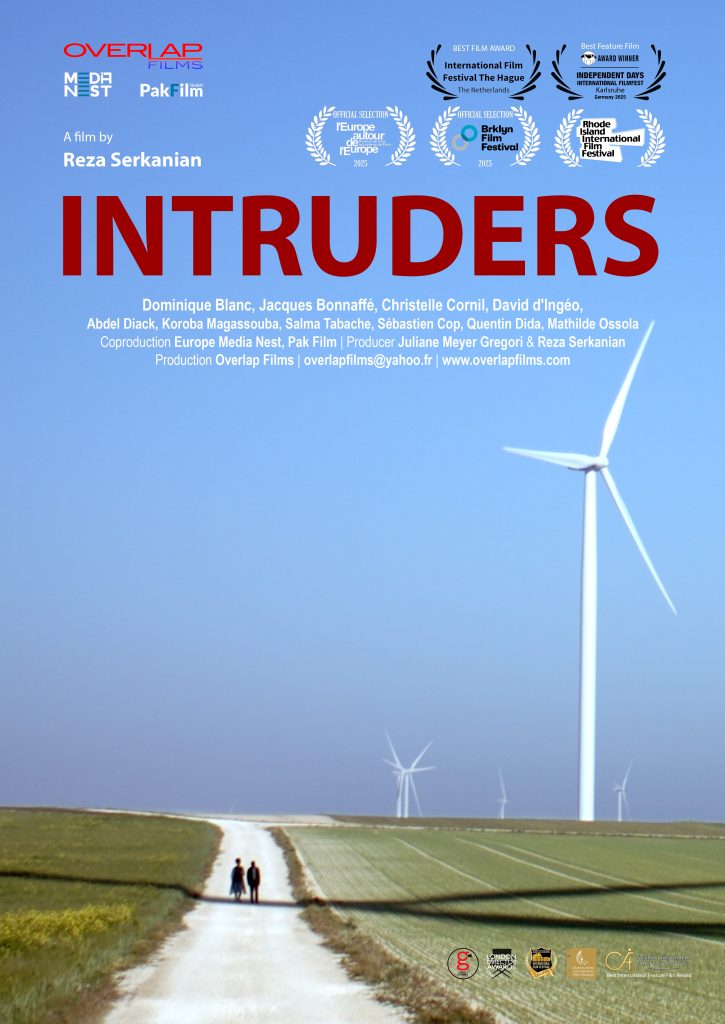
INTRUDERS
Director: Reza Serkanian
Cast: Dominique Blanc, Jacques Bonnaffé,
David d’Ingéo, Christelle Cornil,Sébastien Cop, Marie-Pierre Barrière
Abdel Diack,Koroba Magassouba,Salma Tabache,
Quentin Dida,Mathilde Ossola,Ibtissam Bouchaara,Carole Remy
Script, DOP, Editing: Reza Serkanian
Director’s assistant: Sébastien Cop,
Cameras: Stéphane Lecyn, Sound: Philippe Schillinger,
Sound editing & mix: Matthieu Dallaporta
Sound Post-production: Rodéo Films & Gump
Co-productions: Europe Nest Media (CZ) & PakFilm (Germany)
Country of Production: France
Distribution: Overlap Films
Release in France: 2026 – Available on DCP – Video – DVD
Links: Allociné – UniFrance – IMDB
Year: 2026
Language: French
Genre: Drama
Duration: 80 min – Fiction
Shooting Format: 4K – 4608 x 2592
Aspect Ratio: 2,39






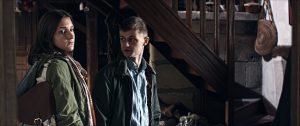
Watch the trailer
Festivals
– Rhode Island International Film Festival (USA)
– Brooklyn Film Festival (USA)
– Europe Around Europe (FEAE) (Paris, France)
– Girona Film Festival (Spain)
– Independent Days | Karlsruhe International Film Festival (Germany) Best Feature Film Award
– The Hague International Film Festival (The Netherlands) Best Film Award
– Toronto Independent Film Festival, CIFT (Canada) Best Feature Film Award
Read Full Article About the Film
On a secluded farm, a few young migrants have found a fragile balance. But in a single day, everything can change. Leave or stay? Seize this fleeting feeling of freedom on this farm where time seems suspended? Accept these unexpected encounters and their impact on each of their destinies? After this initiatory night, dawn breaks. A gunshot rings out… the end of innocence, of childhood, so dear to Bresson, the child’s choice to kill the innocent animal… Resuming the journey toward a still unknown destination.
From documentary to fiction.
For my latest documentary, “Playmakers“ I met, followed, and filmed unaccompanied minors, mostly from Africa, to understand their journeys, the conditions of their exile, their dreams, their frustrations… I was struck by the strength with which they faced adult problems, even though they were just children. Through the stories of these young foreigners, I rediscovered what I had felt more than twenty years ago when I arrived in Europe.
Originally from Iran, I experienced cultural uprooting. Upon arriving in France, I was welcomed by a farming family living in the Normandy countryside. I had the opportunity to share their daily life and witness their struggle to live in harmony with nature, while also bearing the administrative burden of managing their farms—an additional job far removed from their chosen vocation. I discovered France through these humble people. This first home and this first experience in France left a deep mark on me. Since then, I have always wanted to make a film about rural life to show my adopted country as it first appeared to me.
It was a long wait, until this film project about young migrants came along and enriched my vision. The farm in a remote village, where migrants and locals could meet, seemed to me the perfect setting to blend these two worlds, to create a microcosm of society.
Because rural areas have strong family traditions, the family setting seemed the obvious choice. The decision to have young people of foreign origin living with a family in turmoil gives rise to contradictory and sometimes comical situations. The family context allows me to explore both the disconnect and the complicity between the protagonists.
Two worlds collide:
The migrants, orphaned of parents, family, and friends, are searching for a decent life in a world that distrusts them. The approaching age of majority looms large over them, and jeopardizes their future in the country they chose to seek refuge in.
A broken, fractured, and torn family, with a father losing his grip on reality, and children who no longer understand their mother, whom they deem incapable of managing her own life.
Whether it’s the young foreigners or the members of this French family, everyone feels abandoned and heartbroken. The clash of these two worlds begins on Corinne’s farm. A place of refuge for some, a place of tragedy for others. A sacred place for all. The farm is a rallying point for characters who are complete opposites and who should never have met.
Through his incantations, the griot summons Corinne back to their midst around the fire to celebrate the reunion of those she loves, who come together despite their differences and prejudices. Corinne arrives like a deliverance, like a messiah, who doesn’t moralize but observes the devastating effects of a consumer society on the human condition. She embodies the hope and warmth of humanity. The
Film
INTRUDERS explores the question of otherness and tells the story of the other across the globe. With humor and irony, the film observes the behavior of characters brought together in unusual and unexpected circumstances, against their will, burdened by deeply ingrained prejudices and stereotypes.
Here, cultures clash, and family and social worlds collide. Sheltered in this farmhouse, the young, naive, and well-meaning strangers confront a reality they never suspected: mistrust and suspicion, lies and deceit.
This French family, suffering and torn apart, embodies, across two generations, a different idea of integration. While the father, from an isolated and austere rural background, withdrawn, somewhat uncouth, and full of prejudices against foreigners, behaves like an old colonialist, his children seem more open to the idea of integration. But their apparent goodwill towards foreigners is actually tinged with condescension, which is often the source of many misunderstandings.
Today, these young Africans, like the protagonists of the film, aspire to change their destiny. They sometimes manage to leave their country of origin and follow the path laid out by the former colonists who came to exploit its resources. This exile, an act as voluntary as it is painful, carries hope because these young people express a strong desire for emancipation, diversity, and new relationships.
This film recounts the traditions and mindset of rural inhabitants, while also speaking about the world. And this is to show how, in our everyday lives, the stranger is always similar to us, while the similar is often foreign to us.
These are the reasons why I felt a strong and vital need to make this film. Because I have had the chance to know these two worlds, these two realities, because I was moved by them, because I want the world to open its eyes and look around it, because I hope that this film will provoke questions, create reflection.
The tone
In THE INTRUDERS, irony plays a crucial role in confronting what appears meaningless, even absurd. While the seriousness of the issues addressed easily lent itself to a political film, a thriller given the investigation, or a mystery film considering the strangeness of the unfolding events, I chose to adopt an ironic tone, highlighting the disconnect between the characters and their different worldviews. The dramatic aspects and the investigations into Corinne’s mysterious disappearance are deliberately relegated to the background, as the film is based on the clash of these different worlds and the resulting inconsistencies. The irony of fate, from which none of the characters seem to escape, is present throughout the film to better underscore the absurdity of life. For me, the film’s originality lies in its ironic storytelling.
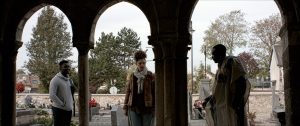
For example, the tone is set from the very first images: a young man, wearing a boubou, is performing his Muslim prayers in a small Catholic church; The hygiene inspector, whose dehumanizing attitude contrasts sharply with the young migrants’ acts of hospitality, even though they themselves are out of place; Rodolphe, the frustrated father, preoccupied mainly with the fate of his shack, “the only territory he has left,” watches the family farm transform into an African territory during the initiation ceremony; while the young migrants fully appreciate Corinne’s maternal warmth, her own children criticize her, try to disarm her, and prevent her from acting; Moussa finds himself caught between his family traditions, the precariousness of his situation, and the image of the French father being presented to him; even Corinne is not spared this irony of fate. Her gentleness and kindness toward these young people (she helped Moussa return to France, among other things) are turned against her when she is arrested and taken into custody. As if her humanity were a crime…
The music also sets the tone. The spirit of Jean-Philippe Rameau’s opera-ballet “Les Indes Galantes” resonates with the film’s themes. I chose this opera because it reflects the ambiguous gaze that conquering Westerners cast upon the Other, the savage. It speaks of the violence of domination and the will for emancipation. The melody that can be heard at times in the film is that of the fourth act, “Les Sauvages,” which symbolizes the reconciliation between conquered peoples and the colonizing armies. Today, “Les Indes Galantes” carries a spirit of derision and irony that also suits the tone I wanted to give my film.
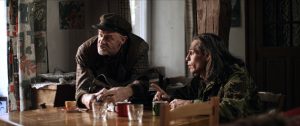
Corinne connects all the characters. She is both what unites them and what divides them. Her absence provokes these unexpected encounters and reveals the characters’ personalities and states of mind, influenced by their individual journeys: Rodolphe’s behavior when he questions the young people about his ex-wife reveals much about his past in Africa. Or again: Ibra’s confinement in the basement reminds him of his imprisonment by rebels in the desert. Even if he doesn’t want to speak about it explicitly, a small sign of empathy from Rodolphe is enough for him to express the full extent of the suffering of his exile.
Corinne’s absence acts as a catalyst. Each character can see a metaphor in it by projecting their own vision: a loving and protective mother to the young migrants, an irresponsible mother to Corinne’s children, a lost soul to her ex-husband, a lone wolf to her activist friends, an outlaw to the police.
The other characters must then continue to search, each in their own way, for their place in society, sometimes without succeeding.
Director
REZA SERKANIAN

Biography
Reza Serkanian is an Iranian-born filmmaker active for over three decades in fiction and documentary. He began making short films at seventeen in Iran and gained early international recognition, with two selections at the Clermont-Ferrand Short Film Festival. After studying cinema in Tehran, he continued his artistic development at the Rijksakademie van Beeldende Kunsten in Amsterdam. He has been based in France since 1998 and works across Europe, Africa, and Iran, focusing on social realities and human relationships. He also works as an editor and cinematographer. His first feature film, Ephemeral Wedding, received the Sopadin & France Culture Screenplay Award and premiered at the Cannes Film Festival in 2011 before its release in France. After Playmakers, a documentary co-produced with France 3 for television, his new feature film Intruders will be released theatrically in France in 2026.
Filmography
INTRUDERS
2026 – Fiction – 80 min – Overlap Films – France
PLAYMAKERS
2020 – Documentary – 68 min – Overlap Films – France
CHILDREN TREADING THE BOARDS
2019 – Documentary – 52 min – Overlap Films – France
THE ROCK OF NARAYAMA
2018 – Fiction – 15 min – Overlap Films – France / Iran
EPHEMERAL WEDDINGS
2011 – Fiction – 83 min – Overlap Films – France
THOSE WHO EAT WOOD
2008 – Documentary – 50 min – Overlap Films – France / Gabon
ADRIEN’S ABSENCE
2004 – Documentary – 26 mn – Overlap Films – France
REUNION
2003 – Fiction – 25 min – 35mm – Overlap Films – France / Iran
IN PASSING
2002 – Fiction – 19 min – 16mm – Polygone Films – France
RETURN
2000 – Fiction – 30 min – 16mm – Valor Films – The Netherlands
PARASTOU
1995 – Fiction – 31 min – 35mm – Iran
BIRD IN THE WIND
1993 – Fiction – 42 mn – 16mm – Iran